

The Obsession
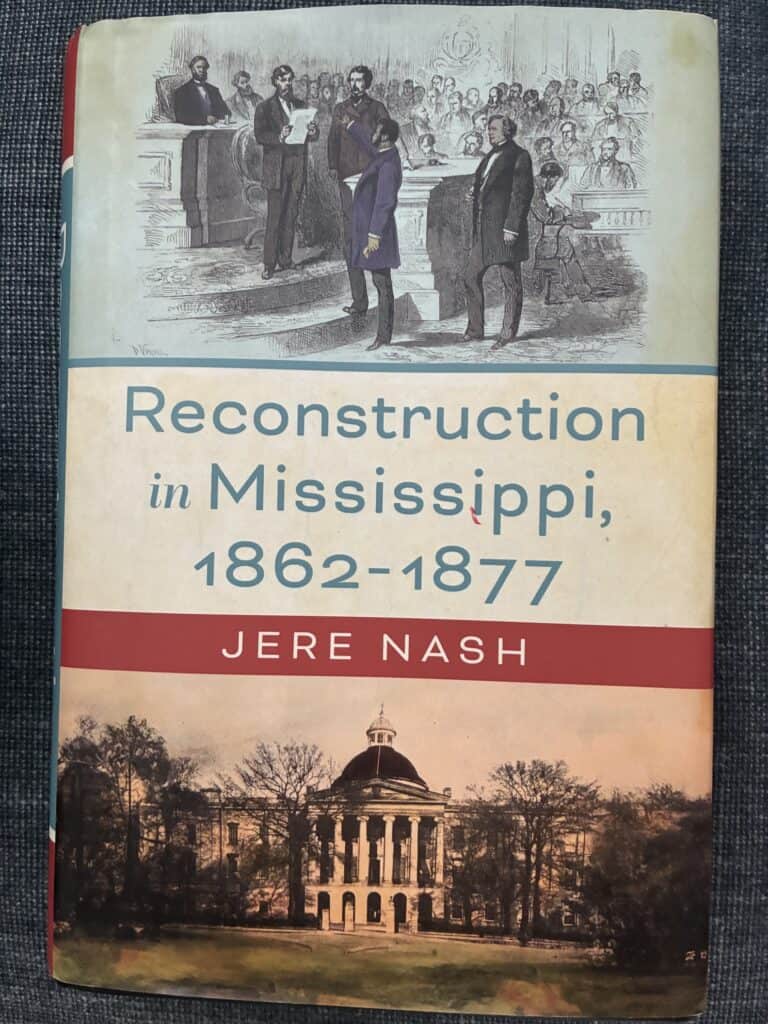
Obsession is probably not the primary take-away the author of Reconstruction in Mississippi, 1862-1877, intended. But I read a statistic in Jere Nash’s book that shocked me, and pointed toward the price of obsession.
The Slide from Slavery Wealth
In 1860, Mississippi was per capita the wealthiest state in America. The economy was 7th overall in hard numbers, producing the largest 1.2 million bales of cotton in the country. Cotton, in the mind of these planters, meant enslaved labor, and one third of the state’s revenue came from a tax on enslaved people. By 1870, the state’s wealth ranking had dropped to 26th. Ten years AFTER the war, we were in 26th place. As my husband points out, in 1870, there were only 37 states; still, we weren’t last.
So, as the number of states increased, why did we continue to lose ground and drop to—and stay at—last place?
Answer: Because even as the price of cotton fell and buyers turned away from Southern cotton in favor of new producers who had entered the market during the war, Mississippi planters rode that cotton horse until it dropped. For decades and decades and decades, they made this disastrous choice despite everyone and their brother urging them to diversify their crop. A damning decision for the state’s economy and for the people it harmed, for everyone.
Obsession Overrules Logic
Why did they follow this path to the bottom?
Reconstruction in Mississippi rolls through the reasons historians cite. “Financial and legal constraints, cycles of poverty and dependency, accumulation of debt, dearth of capital to invest in new equipment….” But, in the end, the historians can only shrug, ”It’s a mystery.”
Ask me (which no one does), historians are blinded by believing men rational. In truth, the planters’ mangled egos—loss of the war, of wealth, of the right to enslavement that defined their economic and personal worth as white people—prevented their brains from functioning properly. Logic and intelligence went out the window, overwhelmed by the desire to GO BACK. To make money the way we once had. To recapture the cotton dream, or at least regain our right to strive for it. Wipe out even the memory of the disasters and return to being the wealthiest state in America.
Those making economic and political decisions refused to believe we were wrong about the war, wrong about slavery, wrong about cotton, and wrong about our racism. They could handle the state sliding into an economic pit more than they could take giving up those beliefs.
The Obsession Gets Worse
Reading all these histories about Reconstruction and slavery, I can’t shake one thought. Nash quotes Ross Moore on white Mississippians in Reconstruction fighting interference with their “handling” of their laborers. Freedman Bureau officials reported the same, using more graphic language. Of course, violence maintained slavery. After emancipation, white violence against Black folks engorged. When I read this, it puts me in mind of violence spiking when an abused partner leaves the abuser. It’s the most dangerous time for the brave one fleeing, the time most likely to end in their death.
An insistence on the right to beat your laborers. Rage at being denied it. The “shameful humiliation” of Blacks gaining freedom. The resulting epidemic of violence that an observer described as, “outrages committed which History must hand down as only equaled by the most uncivilized of the Human Race.” The continuing historically-documented obsession of white Mississippians with Black Mississippians. This is not just functional violence. It’s violence as psychopathic illness. The Southern “plantation”— which we historically portray as “genteel”—was a breeding ground for mental illness that has dominated us for generations.
What If?
The question rumbling in my brain is, what if? What if the powers-that-be in Mississippi had listened and chosen a path other than cotton? If we had abandoned our obsession, the social control of lynching violence wouldn’t have been necessary. Jim Crow, redundant. Under a different economy, we could have been free to heal from our “Southern way of life,” a phrase that if I never hear again, it will be too soon. That which is so beautiful in the state and its people could have dominated our communal lives. We can still do it, if we give up defending, and repeating, our past obsessions.
Mississippi history, Reconstruction in Mississippi, slavery as psychopathic illness, slavery violence as obsession
Pearl Shaw
Thanks Ellen for sharing these insights and Nash’s book
Ellen Morris Prewitt
You’re welcome. I’m about ready to be finished with this Reconstruction history reading project. I have two more books, one of which is Du Bois’s, which is so big I almost can’t pick it up. Onward!
Emma
Oh Ellen, i must read this book! So many of us born in Mississippi are flummoxed over the mystery of why our state remains obsessed with the past. Although most people here will deny that fact, the truth is that we (Mississippi) is always first in what is bad and last in what is good. Yes, great improvements have been made in education, and we are no longer 50th in many areas, but in general we remain #48 in overall child well-being and health, and there is a huge gap between education and overall living conditions. And that is mostly because of our ranking #48 in the economy. With no major industries to speak of (except Ingalls shipbuilding), major industries are agriculture, forestry and catfish. The 13th Amendment, which abolished slavery, was ratified after three-fourths of the states passed it in 1865 at the close of the war. Mississippi did not symbolically and officially adopt it until 1995 – and didn’t officially notify Washington of the vote until 2013! How long, how long, must our residents live with the obsessions about the past that you speak of? How many generations must this ‘mental illness’ pass through until it goes away?
Ellen Morris Prewitt
These Reconstruction histories are so hard to read. They make clear the opportunities that were violently killed. Never before reading this book, though, did I stop to question my assumption the devastation of the Civil War (which was totally true) threw us to the bottom of the economic ladder. In hindsight, it doesn’t make sense, as all the other Southern states went through the war too. So why us? So many bullheaded, racist decisions. (After reading this book, I look at Natchez antebellum tourism and think, yep, they want to remind everyone: we used to be somebody.) I join you in praying we can throw off these obsessions and move more freely into the future.
Marcee
Lord your words hit hard. With the clarity of truth. And deep sadness. Thank you for writing them and giving them to us.
Ellen Morris Prewitt
And thank you for reading them, Marcee, even knowing they are not going to be easy. 💔