

Lies of History
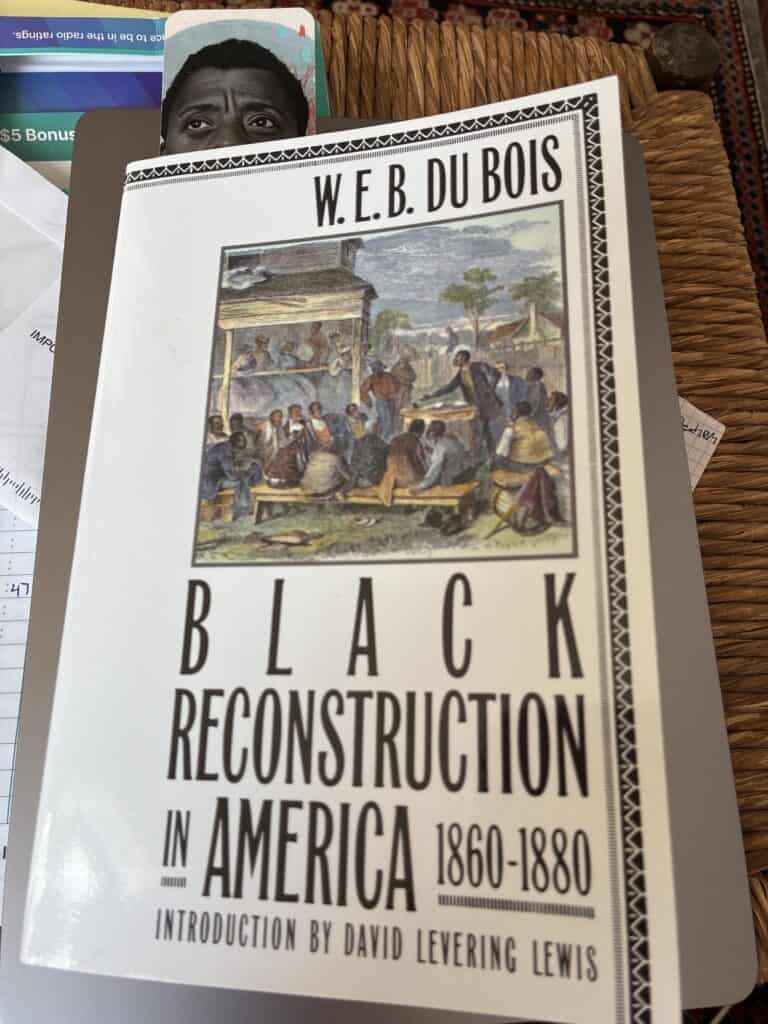
Rarely do I write a book review mid-book. But W. E.B. Du Bois’s Black Reconstruction in America: 1860-1880, has so fascinated me, I need to share. Of course, lies of history are gonna rivet me. Besides, the book is over 700 pages, so I might actually need three posts to cover it.
Here’s a primary premise of the book: Americans of African descent were instrumental in winning the Civil War for the United States.
Lies of History Commission
Du Bois published his book in 1935. The book was, in part, an answer to the racist-ass historians who had dominated national discourse since the end of the War. History calls them “The Dunning School”, after a Columbia professor who promoted and taught his racist-ass views. (I’m no longer using the word “conservative” when what people are is racist-ass.) These racist-ass white men were responsible for sanctioning the Lost Cause Myth. Specifically, that “Reconstruction was a colossal failure because Black folks were so ignorant and corrupt,” one of the greatest lies of history.
Du Bois will refute that hateful theory. Right now, he’s telling us how Black Americans won the Civil War. His argument includes not just how the enslaved walked away from the work that sustained the Confederacy—keeping the plantations running, supplying the food—but how both armies eventually admitted they could not win the war without Black soldiers.
Lies of Omission
Not just the North. The Confederacy eventually voted to arm as soldiers the men they intended through their war to keep as chattel property. Over 180,000 African Americans served in the war. Yet, our country did not erect a national park memorial honoring Black Civil War soldiers until 2004. Apparently, white descendants on both sides of the war want to retain the fiction that freedom was something done for Black Americans not by them. No one is teaching us that we owe the United States of America to Black soldiers.
In other words, the entire nation cooperated in creating a history of our most rending historical moment that is 100% fiction.
Lies Told Me
What gets me heated about this is the lying of it. The historians and film makers and book writers planted these lies of history into MY brain. Not just as a child. It continued long into my adulthood. Even today, we’re still making films and TV series perpetrating the lie of a “white” Civil War. All I can say is I guess I’m grateful to know the truth later if not sooner.
Lies of history, Reconstruction in America, W. E. B. Du Bois
Mary Lowry
Totally eye-opening! Thank you for bringing this book to my attention.
Ellen Morris Prewitt
My history professor friend said, “It’s a classic history book that all historians know about and some have read.” 🙂
Jean Ewing
Love that you have adopted the truer racist-ass designation. I have this book on my bookshelf, but haven’t read it. Ten years ago when I began reading it, I posted on fb an invitation to anyone to form a discussion group for the book. I felt so betrayed by what I had been taught and wanted to process it with someone who had a similar background.Two friends accepted, but they were both yankees who couldn’t relate…
Ellen Morris Prewitt
We can have our own discussion group–I can relate. 🙂
Emma French Connolly
And it saddens me that it is still happening. I wish all of us baby boomers were healthy enough, black and white together, to march from here to Washington like our counterpart did during the civil rights era. Sadly, most of us are on canes or walkers these days. And it does not seem as if the millennials feel the imminent need to do anything big. Of course that’s a blanket statement. That’s probably not true with the current administration’s propensity to promote lie. After lie we don’t know what the truth is anymore unless we dig for it.
Ellen Morris Prewitt
“We don’t know what the truth is anymore unless we dig for it.” That is the absolute truth!
Joanne Corey
Justin Jones, a Black representative in the Tennessee state legislature is calling for a new Freedom Summer in this conversation with Robert Reich: https://robertreich.substack.com/p/how-to-respond-to-the-rebirth-of
Ellen Morris Prewitt
Tennessee is outdoing itself. It has now stripped all Democrats of all committee assignments. (and is Rep. Pearson that tall or Reich that short?)
Joanne Corey
Robert Reich is under five feet at this point. I think he may have been a bit taller in his younger years but not much. He writes about it variously. His short stature kept him from being drafted during the Vietnam era, which was a big relief.
Ellen Morris Prewitt
Good to know!
Jim Van Hecke
Our country has had a disgraceful history with how we treated women and people of color. We made some amends with some legislated changes in the 60’s but unfortunately most bigots will always be bigots and our bigoted President is leading the charge to dismantle all progress…..alas,…keep the faith that he won’t be successful!!!
Ellen Morris Prewitt
I am woebegone over the “undoing” going on, Van. I keep thinking we will get back in charge and undo the undoing, but we are going to inherit a wrecked system. And sometime I lose faith we will be able to get back in charge!
Joanne Corey
Going back further in US history, one of the things I appreciated about Ken Burns’ series on the American Revolution was the large role that Black people played, including in the army.
Ellen Morris Prewitt
Now, I did not know that. We slant our history so hard by what we choose to tell and what we choose to leave out, don’t we?
Joanne Corey
Yes, which is why it’s distressing that lately there is a push to remove anything other than the white Christian male perspective from our history. I learned as a child that Crispus Attucks was killed in the Boston Massacre but not much about Black people during the Revolution. I was fortunate, though, to have taken a semester-length history course on minorities in America in high school. I don’t know if those kinds of courses exist any more or how much of that content has been incorporated into general history courses.
Ellen Morris Prewitt
I told my husband last night that writing this memoir on my family’s role in history and reading these Reconstruction books is hard. I just have to put it down sometimes. Take a breath. Absorb the grief. I wonder how much easier would it have been to learn this as my first understanding of history? In your minorities history course, did they prepare you emotionally for what you were learning?
Jep Barbour
This appears on the NPS website and describes the background on the 54th Mass Regiment. The monument was unveiled in 1897 Boston and it is enormous. Something everyone should see.
Robert Gould Shaw and the 54th Regiment
frontal view of the MA 54th Memorial, a bronze sculpture surrounded of soldiers marching
Robert Gould Shaw and the Massachusetts 54th Memorial
NPS/Teuten
The Robert Gould Shaw and Massachusetts 54th Regiment Memorial commemorates one of the first Black regiments of the American Civil War. Although African Americans served in both the Revolutionary War and the War of 1812, Northern racist sentiments kept African Americans from taking up arms for the United States in the early years of the Civil War. However, a clause in Abraham Lincoln’s 1863 Emancipation Proclamation allowed for the raising of Black regiments. Governor John Andrew soon created the Massachusetts 54th Volunteer Infantry. He chose Robert Gould Shaw, the son of wealthy abolitionists, to serve as its colonel. Notable abolitionists including Frederick Douglass and local leaders such as Lewis Hayden recruited men for the 54th Regiment. African Americans enlisted from every region of the north, and from as far away as Canada and the Caribbean.
Through their heroic, yet tragic, assault on Fort Wagner, South Carolina on July 18, 1863, in which Shaw and many of his men died, the 54th helped erode Northern public opposition to the use of Black soldiers and inspired the enlistment of more than 180,000 Black soldiers into the United States forces. Sergeant William H. Carney, severely injured in the battle, saved the regiment’s flag. For this act of bravery, he became the first African American recipient of the Medal of Honor. The 54th Regiment also fought in engagements on James Island, the Battle of Olustee, and at Honey Hill, South Carolina, before their return to Boston in September 1865.
Augustus Saint-Gaudens took nearly fourteen years to complete this high-relief bronze monument, which celebrates the valor and sacrifices of the Massachusetts 54th. One of the premier artists of his day, Saint-Gaudens grew up in New York and Boston, but received formal training at the Ecole des Beaux-Arts Paris. In his studio in New York, he hired forty men to serve as models for the soldiers’ faces. Paid for by private donations and unveiled on May 31, 1897, this monument depicts the 54th Regiment as they marched down Beacon Street off for war in 1863.
The Memorial is located on Boston Common directly across from the Massachusetts State House on Beacon Street.
Ellen Morris Prewitt
Thank you! I needed to know that. Apparently, the Bostonians were ahead of their time.