

Vonnegut
When I was in high school, I favored a small library located in a strip center. The library shelves began as soon as you walked in the door. From my weird spatial perspective, the library arranged the books backwards—the cataloguing began at the front desk, placing the fiction authors whose names were at the end of the alphabet closest to the door. I remember this because I’ll never forget squatting on the floor and finding on the bottom shelf under the “V” Kurt Vonnegut.
I was in the twelfth grade, in an Advance Placement English class. The class gave extra credit for reading. Can you believe that? Extra credit for reading, my favorite thing. Anyway, I found Vonnegut, whose books were small, at least compared to Moby Dick, which we’d read in class. I checked out a couple of them. Slaughterhouse Five and either Cat’s Cradle or Breakfast of Champions, I don’t remember. If a book was not on the Extra Credit list, the teacher had to approve it. Approval had not theretofore been an issue.
Is Vonnegut Okay?
The teacher took my request under advisement. She was older, her gray hair sweeping up dramatically into a bun. When she took the books from me, as always, her hands trembled. Corralling stray wisps of hair from her forehead, she said she’d let me know.
Several days later she stopped me from leaving class. My choice, she said, was not conventional. The language, the scenes—the book contained objectionable material. It was, she sniffed, not her cup of tea. She concluded, however, that I was probably mature enough to decide for myself the value of the book.
The year was 1974. Slaughterhouse Five came out in 1969, Breakfast of Champions in ‘73. Vonnegut had won Hugos and Nebulas, but he was not yet a classic, to say the least. I got the distinct impression the teacher had not yet read him; hence, the delay. But thanks to her begrudgingly open mind, Vonnegut taught me to never separate fantasy from literature.
Reality or Fantasy or Literature
Maybe this mindset was birthed years earlier when my mother read us the Narnia Chronicles at bedtime, me hating to see the white space that signaled a chapter’s end. Later in my senior year, I had my Asimov phase, and one summer I devoured C. S. Lewis’s Space Trilogy. In college it was Lord of the Rings; later, Hitchhikers Guide to the Galaxy and every Arthurian legend book ever written.
None of these classics did I consider “fantasy.” They were just great books, no different from Moby Dick and especially not hallucinogenic William Faulkner. Even when the author is striving for reality, it’s only verisimilitude. The reality contained therein is the author’s created world.
My literary fantasy When We Were Murderous Time-Traveling Women has dead people returning to today’s New Orleans. The novel cranks up history—my personal history and the city’s. Where does its reality end and fantasy begin? With the treatment I’ve given it, nothing in it is true. And it all is. I think Vonnegut would have approved.
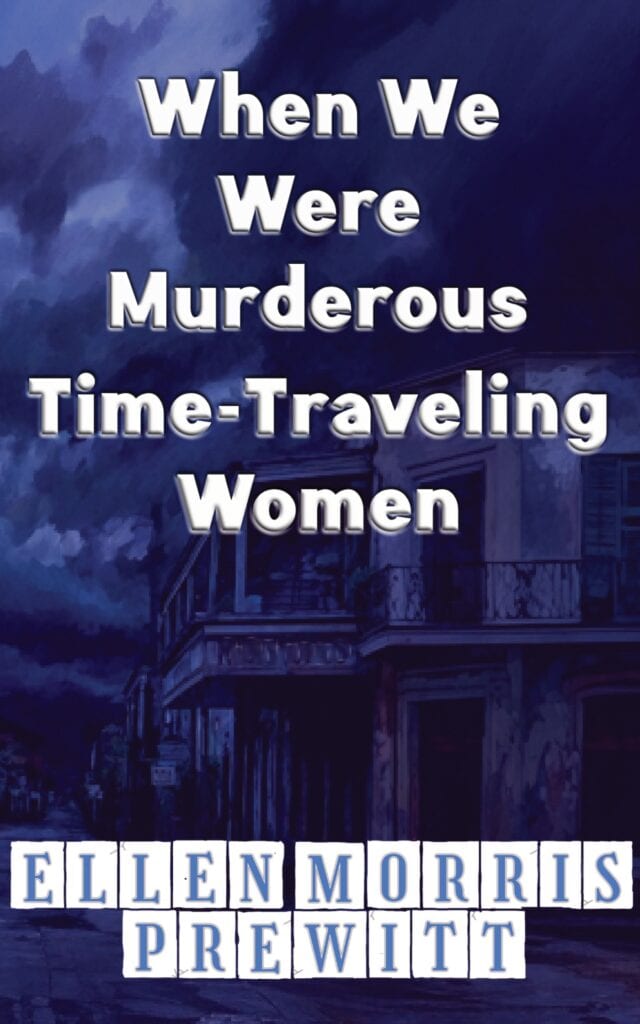
Kurt Vonnegut, Slaughterhouse Five, When We Were Murderous Time-Traveling Women
jerry l harber
Had no idea you were a sci-fi fan! I joined the sci-fi book club when I was still in jr high. I amassed over 400 books and only left the club when science fantasy became more popular than what I considered sci-fi. My older son now has my collection. Except for Asimov. Had to keep the Foundation original, and the prequels and sequels. Have read the Foundation trilogy way more than once. I like Kurt as well.
Ellen Morris Prewitt
The things we learn… And you have Asimov originals! I am duly impressed. 👍 (hope you can come to the book signing at Novel May 2) 📘
Donna
I’m looking forward to April 1st, Ellen! Not because it’s April Fool’s Day either *wink-wink* … Congratulations!
Ellen Morris Prewitt
😊 Yay!
Marie A Bailey
Well, that’s a fine introduction to your new book! And, yeah, this idea that fantasy is separate from literature does seem odd. I’d argue that what it comes down to is the writing. If a book is well written, while you’re reading it, you’ll believe that people can time-travel and that hobbits exist.
Ellen Morris Prewitt
😊 I hope people BELIEVE while they’re reading When We Were Murderous Time-Traveling Women!
Luanne
I read a lot of Vonnegut in high school, but then I had an English teacher who taught 20th century American novel and American Ethnic Writers, so we read all the good stuff. My favorite was Cat’s Cradle.
Ellen Morris Prewitt
How wonderful! For decades, when I read a book I liked, I went back and read the author’s entire oeuvre (though I didn’t know that word.) Not sure when that started, but I do remember doing that with Vonnegut, but I don’t remember my favorite!