

Reconstruction Is Not Easy
This was my reading pile for my literary hibernation between Christmas and New Years. So far, I’ve read two of the books in this stack. One of the books is among the most difficult books I’ve ever read. Reconstruction is not easy, y’all.
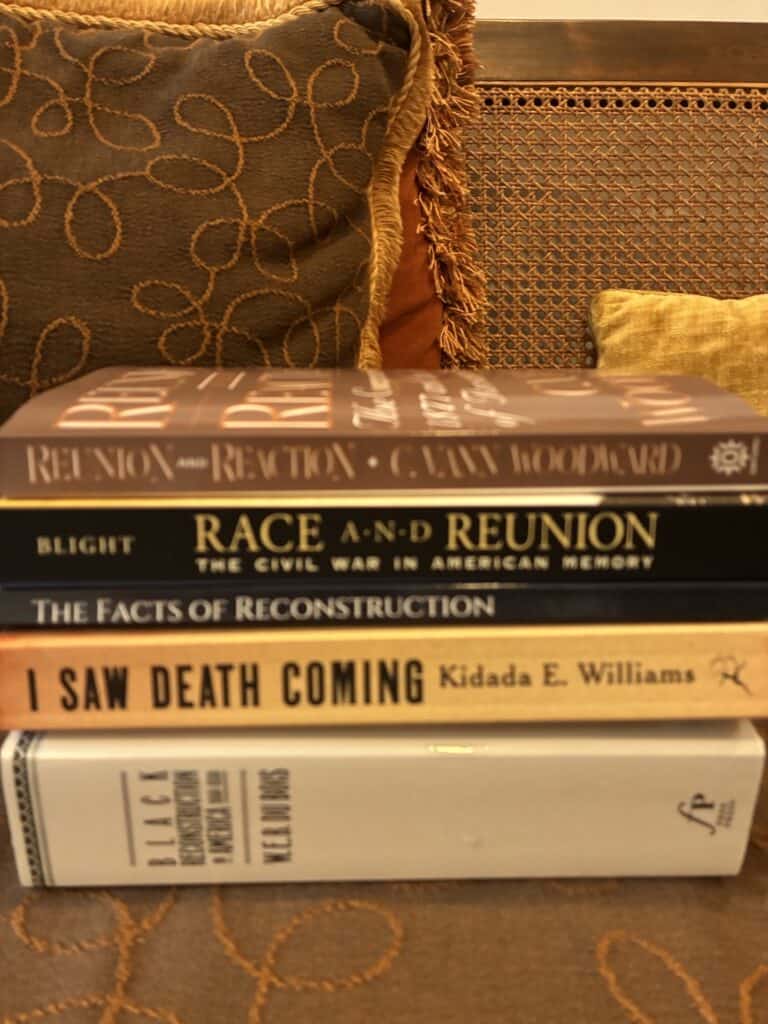
You know about my family history with Reconstruction. My Scoundrel ancestor planned, instigated, and participated in the Vicksburg Massacres. You can read my essays in the Mississippi Free Press or Salvation South if you want to know more about that. Anyway, I usually pick a theme for end-of-year reads. This year I chose Reconstruction because writers I trust recommended these books. Plus, the ancestral grannies in my upcoming novel, When We Were Murderous Time-Traveling Women, lived and had their lives shaped by Reconstruction. For better or worse, it has become my time in history.
I Saw Death Coming
I Saw Death Coming was the really difficult one because it’s based on personal accounts. Kidada E. Williams uses testimony from investigations of Reconstruction violence to describe what Southern whites were doing and why. The subtitle—A History of Terror and Survival in the War against Reconstruction—says it all. Williams makes it clear white Southerners inflicted unrelenting violence on Black Americans until they successfully destroyed everything built up by those released from slavery. Even clearer is the trauma reverberating through the lives of those targeted in these campaigns of violence. The Scoundrel in my family who perpetuated that violence was my grandmother’s grandfather. Just a skip of the stone into the past.
The Facts of Reconstruction
The Facts of Reconstruction also features a personal account, but it’s radically different. John Roy Lynch was a Mississippi representative in the Congress during this time. Lynch takes us from 1867 to publication of the book in 1913. Unlike Williams, whose focus is primarily the focus on destroying Black families, Lynch’s focus is political. He is flat upfront about the white Democrat campaign of violence that nullified the 14th and 15th Constitutional amendments’ guarantee of rights to Black Mississippians. He was very clear on the role Black Americans played in preserving the United States as a country and creating democracy after the war. Until they were stopped.
The book was surprisingly, incredibly engrossing. I learned, for example, that Mississippians didn’t support the state’s famous Constitution of 1890 that kicked off the South’s use of poll taxes, literacy tests, etc to disenfranchise Black voters. The constitution was so unpopular, the legislature refused to put it to a vote of the people. And then it set Mississippi’s world for the next 75 years.
Both of these books refute the view of Reconstruction that dominated historical accounts and popular understanding for generations. After reading them, it’s not hard to understand how the “Reconstruction failed” view took hold. The truth of the overwhelming effort to kill Reconstruction ran too counter to white folks’ interest. If you want to see how very different our country’s history could have been, these books will do it.